

When Kaagaz Ke Phool released in the theatres, it was declared a flop within a week, which disheartened Guru Dutt deeply. This turned out to be the last film directed by him. It was not the lack of prowess that led to the commercial failure of the film, but the inability of the audiences of the time to understand the nuances of the film. Even then, a number of people from the industry came to his support and reassured him that his film would see better times.
Today, Kaagaz Ke Phool along with other films directed by Dutt are revered and studied, doing rounds in various filmmaking schools and under the watchlists of every cinephile. Time allowed people to understand Guru Dutt and his films, which remain distinguished from any other filmmaker’s work in Indian cinema.
Here’s what Dutt did differently in his films-
Integration of Music and Speech
Without making musical scenes boring or repetitive of what was already said by the actors through dialogues, Guru Dutt used music as an extension of dialogues. He used music to advance the narrative. Whatever could not be said through words, had to be expressed through music, in a poetic way.
Guru Dutt didn’t want music to be dull, and stretched out in the screenplay. The opening music sequence had to be brief and entertaining, it should not stall the film. He would often cut from dialogues directly to lip syncing lyrics, rather than wasting any time on setting a musical mood. This can only be found in a Guru Dutt film.
Background as a Dancer and Choreographer
Guru Dutt started his career as a dancer and choreographer, having been inspired by and trained under the dancer and choreographer Uday Shankar. His proficiency in dance choreography enabled him to shoot musical scenes with a distinct style. He would check out every frame with precision beforehand. For instance, the song “Jaane Kya Tune Kahi” in the film Pyaasa (1957) has Waheeda Rahman at its center, with Guru Dutt almost magnetically following her. There is an intrigue in the scene, a question of “Why is he following her”, “Who is she”. So, the song integration doesn’t only provide musical relief but advances the narrative too.
Deep, poetic dialogues
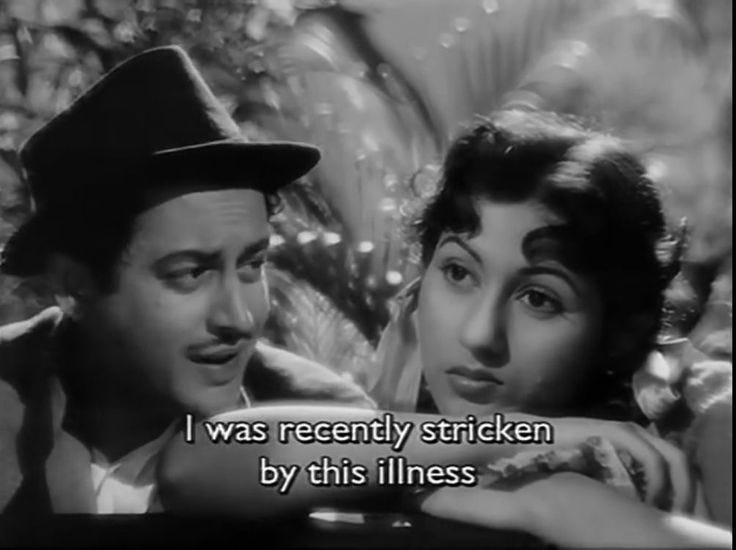
Guru Dutt’s films are special also because of the kind of creative collaborations he became a part of. At the time, Hindustani was the language of choice in our films, which is a mixture of Hindi and Urdu. Guru Dutt collaborated with Abrar Alvi for the dialogues in almost all his films. This is why a uniform poetic and metaphoric style of dialogues can be observed in his filmography.
As an example, we can look at Mr. and Mrs. ‘55. (1955) Guru Dutt’s character is prompted by his lover’s mother if he’s a communist. To this he replies, “I am a Cartoonist.” The writer uses phonetic punning to communicate the character’s professional background, effectively deflecting the question about his political ideology. A cartoonist could still be a communist!
Lights and Shadows
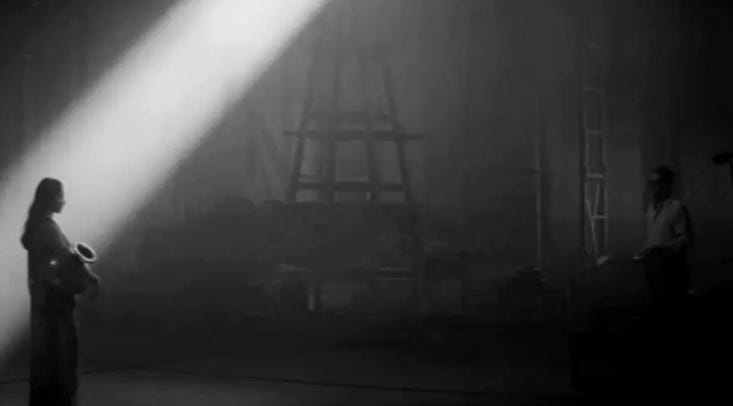
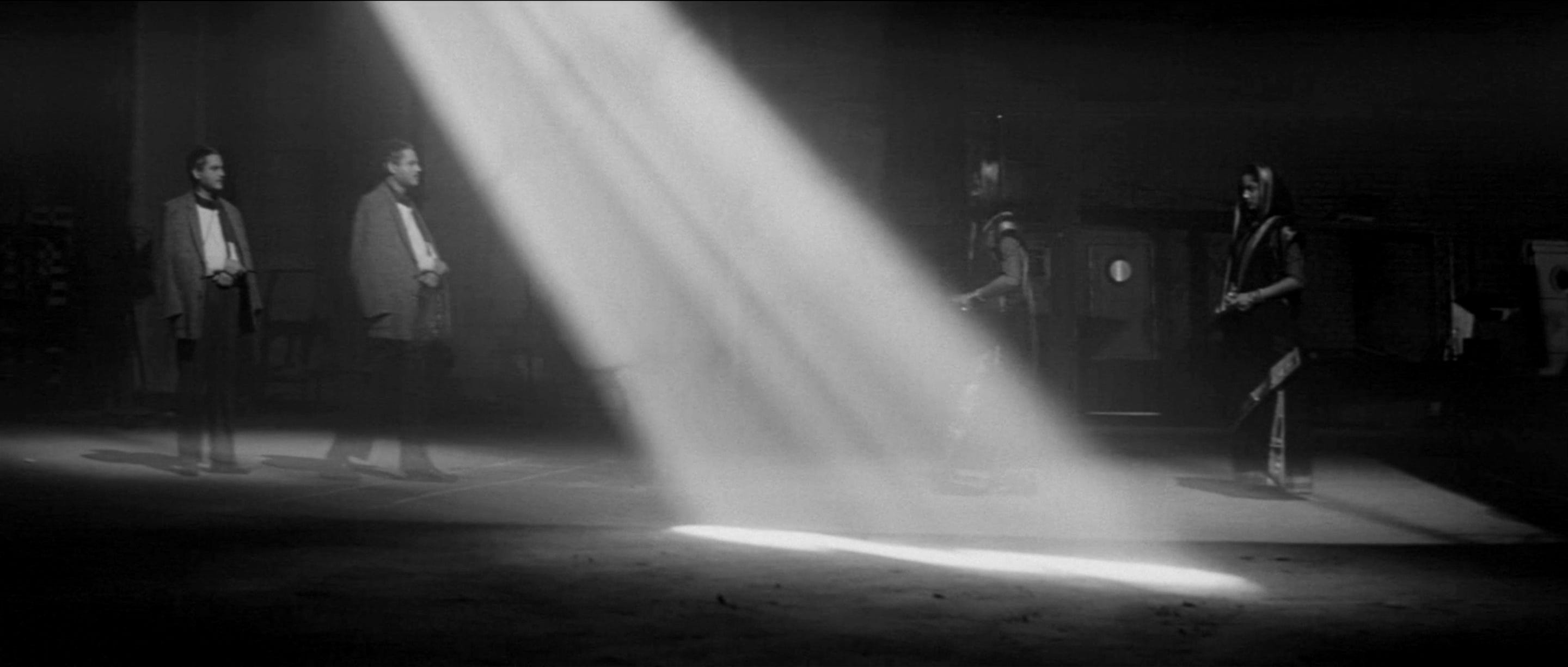
The most memorable shots produced in Dutt’s films are ones that play with light and shade. One that comes to mind is Waheeda Rehman standing at the centre of a room clad in a saree, as light falls only on her; in the film Kaagaz ke Phool (1959). While it literally showed that Rehman’s character is now under spotlight, it could also metaphorically symbolise how the spotlight will shift from star director Suresh Sinha (Guru Dutt) to Shanti (Waheeda Rehman).
Guru Dutt did something differently in the lights department too. Rather than reflecting light on an actor, Dutt would first let the light in, and then place the actor. This led to multiple and random shadows and patterns in all directions, which helped create the stylistic shots that we ultimately got to see.
Cinematography
V.K. Murthy was known as “Guru Dutt’s eye” and worked as a cinematographer on multiple projects with him. Through their creative partnership, Indian cinema earned some unforgettable visuals.
Kaagaz Ke Phool in this regard, remains their most memorable collaboration. It gave us the famous overhead “beam of light” shot during the song Waqt ne Kiya.
Another trademark of Dutt’s films is the closeup shot. For this he used a 100 mm lens to focus on the actor’s face, compressing the background.
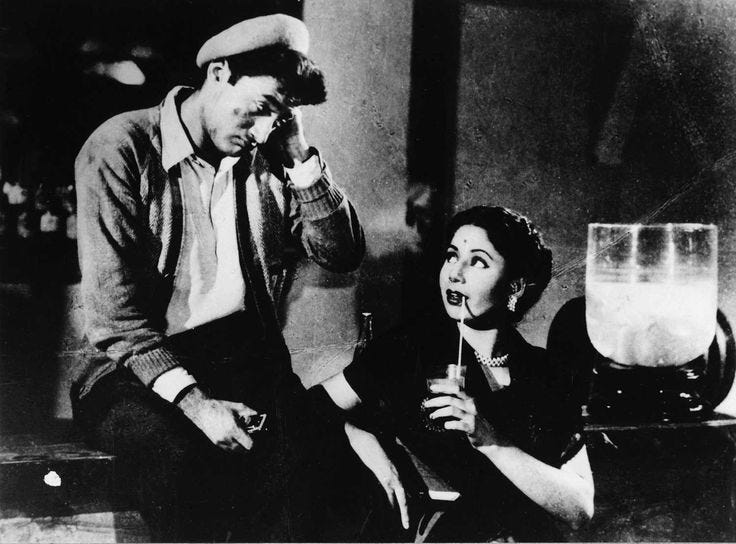
Murthy and Dutt’s collaboration on Baazi (1951) and Aar Paar (1954) also helped introduce the noir aesthetic to Indian cinema. Characters were often submerged in shadows and smoky environments. This was used to emphasize the characters’ moral ambiguity and alienation from the rest of the society.
Guru Dutt’s Inspirations
Dutt’s films incorporated some western styles of filmmaking as well as his own hardships. His films often focused on melancholic characters that were somehow excluded from the rest of the society.
Dutt was inspired by German Expressionism and Hollywood Melodrama which can be seen in his use of dark shadows, strong female leads and a repulsion towards a capitalist society in films like Pyaasa, Aar Paar and Mr. and Mrs. ‘55.
Guru Dutt took inspiration from these works but ended up creating something that was his own, something which was deeply original and never seen before. This enabled Dutt’s work to not only be revered in India but also in the rest of the world.
Though he only directed 8 feature films, Dutt left a deep impression on Indian cinema for times to come. He introduced new styles of filmmaking and song choreography that were never seen before but have since been tried and tested by a number of filmmakers. Dutt introduced men who were melancholic and women who were succeeding in life, he presented a society that disregarded those who strived to do something different, and in the end of it all, Dutt’s art became his life.